


OPINION: Idiagbon: His Life, His Times Till he died last week. By Ayodele Ojo
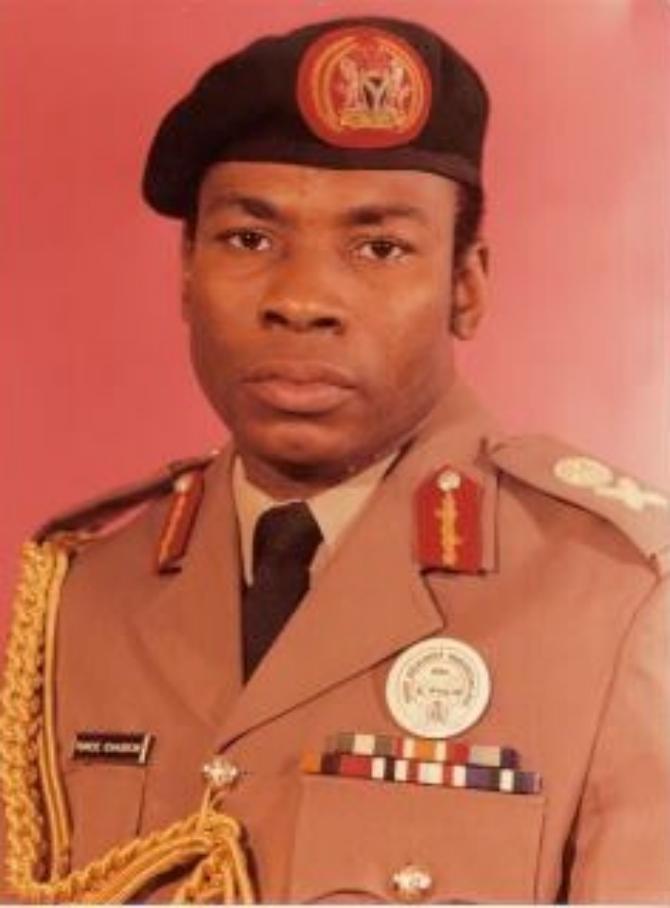
Could he have died from his reported "concern about the state of the nation? Did he die of frustration with the unparalleled corruption, desecration and perversion of the army he joined in 1962 or of the exposure to ridicule, and irreparable damage of the institution he served diligently? Above all, was he poisoned? All these, according to some Ilorin residents who claimed anonymity, will remain conjectures as no autopsy was performed on his remains to determine the cause of death. Born on 14 September 1943 in Ilorin to the late Alhaji Hassan Dogo and Alhaja Ayisatu Iyabeji Hassan Idiagbon he attended United School, Ilorin from 1950-1952 and later Okesuna Senior Primary School in the same town from 1953 to 1957.
He started his military career in 1958 when he enlisted at the Nigerian Military School, Zaria (1958-1962). From there he proceeded to the Pakistani Military Academy, Kakul (1962-65) and later attended a junior commander course at the Nigerian Military Training College, Kaduna.
In 1966, he attended a young officers' course at the Nigerian Military Training College, Kaduna and also a junior staff course in the Nigerian Army Brigade. He was at the Command and Staff College, Pakistan in 1976 and the National Institute for Policy and Strategic Studies, Kuru near Jos in 1981. In 1982, he attended an International Defence Management, Naval Post Graduate School, US (1982). He held a Bachelor of Arts in Economics from the Pakistani Military Academy. An associate member of the Nigerian Institute of Management, Idiagbon is a holder of the Senior International Defence Management Diploma. In 1962, he enlisted as officer cadet and was commissioned as second lieutenant in April 1965.
He was promoted lieutenant in 1966 and captain in 1968. At the end of the civil war, Idiagbon became a major and Lt.-Colonel in 1974; Colonel in July 1978 and Brigadier in May 1980. In the course of a distinguished military career, he held various military posts.
He served as company commander, 4 Battalion, from August 1965 to February 1966; intelligence officer 4 Battalion and later GS0 3 Intelligence, 1 sector; commanding officer, 20 Battalion from October 1967 to February 1968 and 125 Battalion from 1968 to 1970. He was brigade major and deputy- commander, 33 Brigade from March 1970 to March 1971 and commander, 29 Brigade from March 1971 to December 1972.
Appointed general staff officer, grade 1 and later principal staff officer, supreme headquarters from January 1973 to August 1975, Idiagbon was the Brigade Commander, 31 and 15 Brigades respectively from August 1975 to August 1978. While he was serving as Commander, 15 Brigade, he was at the same time a member of the Governing Council of the University of Jos. General Idiagbon's political appointment began in August 1978 when he was made the military governor of Borno State.
He was in this capacity till 1 October 1979. Simultaneously, he was the Commander, 33 Brigade and member of the National Council of State. He served as director of manpower and planning, Army Headquarters from October 1979 to February 1981 and military secretary (army) 1981-1983 from where he was appointed chief of staff, supreme headquarters when the military overthrew the civilians on 31 December 1983. A lover of jazz music of Miles David and Herbie Hankock, Gen. Idiagbon was reportedly tender with his five children, products of Mrs. Biodun Idiagbon whom he married in August 1970. Because he loves his children, Ronke, an MBA student in Cardiff, Wales enjoyed a N1 million pocket money per annum.
Kunle, one of his sons is said to be a business man who's had juicy deals at the PTF. The author of a book titled 'Strategies for Liberating Southern Africa,' he was toppled together with his boss in a palace coup on 27 August 1985 while on a pilgrimage to Mecca with his 14-year-old son. Despite threats to his life, Idiagbon returned to the country a few days after the coup and was detained alongside Buhari for 40 months. After he was released, Idiagbon was a recluse throughout the Babangida years. And despite the disenchantment with his constituency, Idiagbon refused to undertake any risky venture during the Abacha years obviously for fear of arrest or extermination.
"Now he has died like a chicken, killed by a stomach upset," an analyst said. While in government, various programmes were introduced. Among them are the War Against Indiscipline (WAI) which he oversaw and the National Environmental Sanitation which is still in force. But the Buhari-Idiagbon war against drug trafficking, their war against the press and the repression of ousted politicians were the anti-climax of the regime.
The regime's incarceration of many politicians was condemned as barbaric. In fact, many of the jailed governors -Professor Ambrose Ali, Aper Aku, Tatari Ali, Zabo Barkin Zuwo and Alhaji Busari Adelakun died in detention.
Also, the death of Chief Bisi Onabanjo was not unconnected with his prison experience. To deal with politicians who fled Nigeria for Britain, Idiagbon ordered the abduction of one of Nigerian's most wanted fugitives then, Alhaji Umaru Dikko who fled to London and launched from his base plans to return Nigeria to democratic rule without delay. The failed attempt to fly Dikko home in a diplomatic crate sparked off a diplomatic row between London and Lagos. Idiagbon was quoted to have said that: "Normalisation of ties between Nigeria and Britain, if any, must come from Britain because Nigeria did not create the present situation." This was in obvious reference to the request of the British government that the Nigerian High Commissioner to Britain, Major- General Hananniya be recalled for consultation over the Dikko affair. A story in the Sunday Telegraph of 5 August 1984, written by Andrew Phillips entitled "Nigeria's Reign of Terror" ridiculed the regime in apparent reference to the botched kidnap attempt in London.
While the conservative British newspaper castigated the junta abroad, the Nigerian Bar Association, Lagos, on Monday 13 August 1984, issued a communique after its meeting in Lagos expressing concern that decrees that were being churned out of then Supreme Military Council threatened the jurisdiction of courts. Idiagbon was dreaded throughout his sojourn in power. He was the only signatory to the Detention of Persons Decree Number 2 of 1984. But his death, last week, has closed a chapter in Nigeria's history.
Cloud Tag: What's trending
Click on a word/phrase to read more about it.
Matthew Okedare Dunmade Ilorin.Info Ibrahim Mashood Reuben Paraje Naira Redesign Association Of Kwara State Online Media Practitioners Lateef Fagbemi Toyin Saraki AIT Ilorin Abdullahi AbdulMajeed Kwara Hotel Wole Oke Alikinla Olatunji Moronfoye Okin Malt Raimi Iyanda Ita-Nmo Market CKNG Rashidi Yekini Idi-Ape NIRSAL Oloriegbe Muhammed Akanbi Funke Adedoyin Amina Susa\'a De Ahmed Abdulrazaq Sanni Abdulkadir Bolakale Sakariyah Gbemisola Saraki Ayoade Akinnibosun Hassan Saliu Dan-Kazeem Gbemi Saraki Azeez Bello Lotus Bank Musa Aibinu Yashikira Ibrahim Sulu Gambari Photo News NTA Ilorin Iyaloja-General Aremu Bose Deborah Lanre Issa-Onilu Suleiman Alege Kuranga Shaykh Luqman Jimoh Mogaji Aare Abdulrahman Abdulrasak Bayer Nigeria Limited Muhammed Taofeeq Abdulrazaq General Hospital Saheed Alakoso Ballah Mumeen Lah Ishaq Salman David Oyerinola Adedunmoye Rafiu Olasile Abdulraheem Olesin Ayotunde Emmanuel Alao Ibrahim Orire All Peoples Party Shagari Funmilayo Isiaka Oniwa Funmi Salau Bello Abubakar Lai Gobir New Naira Notes Abdulmutalib Shittu Rihanat Ajia Jimoh Bashir Issa Manzuma Toyin Sanusi Obasanjo Abdulwahab Oba Bolaji Nagode Akande Idowu Ayoola Muhammed Oke-Oyi Ibrahim Gambari