


National Assembly's one year of dashed hope
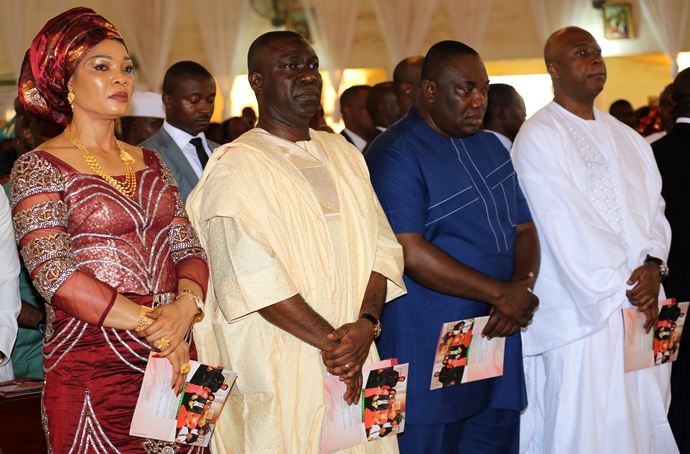
ONE year into the four-year lifespan of the current National Assembly is enough time for Nigerians to make up their minds about what to expect from this present set of parliamentarians. The prospects so far have been anything but cheering. It has been another year of dashed hope for those who had thought that, with a new party, the All Progressives Congress, taking over the majority role in the two chambers after more than a decade-and-a-half of the Peoples Democratic Party in the saddle, things would change for the better. Sadly, it has so far been more of the same.
As usual, the rest of Nigerians are the ones getting the short end of the stick in a system where the lawmakers are using their privileged position to legislate the good things of life for themselves at the expense of the rest of their compatriots. Just like in the past, they are yet to do away with their jumbo salaries and other perks of office, which details they have tried as much as possible to shield from public knowledge. How much each legislator earns has continued to remain in the realm of speculation, even though some foreign publications have put their remunerations, compared to those of their counterparts in other democratic clans, among the highest – if not the highest – in the world.
To them, the current economic downturn, brought about by the mismanagement of the past administrations and the recession in the international crude oil market, are but a fairy tale with no bearing on their own lives. No matter the situation, there has to be enough funds, not only to provide them with luxuries, but to sufficiently hedge against the vicissitudes of life. That is why the senators, a few months ago, went against popular sentiments to buy for themselves 36 cars worth N36.5 million each, in addition to the car loans that each of them had collected. It meant nothing to them that, as they were embarking on that spending binge, 27 of the 36 states of the federation could not pay salaries to their workers.
Given the immediate past history of the country, when everybody had expected the lawmakers to hit the ground running, they spent a good part of the beginning of their tenure fighting for posts. The election of the principal officers was embroiled in a brouhaha that eventually delayed the formation of committees and effective take-off of their legislative duties. Some of the issues arising from that struggle are still lingering one year after, with the court set to adjudicate on them.
If anyone were to approach both chambers of the National Assembly for their achievements, they will not fail to come out with favourable scorecards, listing such "achievements" as the formation of committees and election of principal officers. While the Senate reportedly passed just 11 bills in one year, the Speaker of the House or Representatives, Yakubu Dogara, was quoted as saying that the House received a total of 685 bills, of which 675 were members' bills and 10 were from the executive. Out of these, he said 85 bills had been passed.
However, with the dire economic situation in the country, how many of such bills passed by the two chambers can be said to have been geared towards revamping the economy? For instance, the Petroleum Industry Bill, hurriedly passed by the House of Representatives on the last day of the Seventh National Assembly, but could not be harmonised by the Senate, is still gathering dust, almost one decade after it was introduced. The Minister of State for Petroleum Resources, Ibe Kachikwu, told the Senate last year that the country was losing $15 billion of investment yearly due to the non-passage of the PIB. This is the type of bill that should engage the attention of both arms of the National Assembly.
Also awaiting the attention of the lawmakers is the Railway Act (Amendment) Bill, which has been going back and forth at the National Assembly. There is no modern and competitive economy today that does not have a virile railway system for the movement of humans and cargoes. Especially in a vast country like Nigeria, where goods are moved from the coastal areas to the desert fringes, the rail system offers a viable alternative to the use of other long haul vehicles like trailers. Why can't the National Assembly repeal the law that forbids individuals from investing in the railways now that it has become clear that the government alone cannot handle the railways?
Although there was some tardiness by the executive in the preparation of this year's budget, it will be difficult to exonerate the National Assembly from blame in the eventual lateness in passing the 2016 Appropriation Bill. Rather than carry out its oversight functions of ensuring that the executive deployed the available funds rightly to tackle the needs of the citizens, the federal lawmakers ensured that important allocations for projects across the country were expunged to make way for their own constituency projects, which could, at best have been handled by their local governments.
Unfortunately, Nigerians do not seem to appreciate the importance of the parliament in a democracy and are therefore not concerned enough to act on their failings. But this is the time for them to rise up and demand performance from their legislators. It is also time to decide whether the resources deployed to maintain the 108 senators and 360 House of Representatives members are commensurate with their output. Can the economy continue to sustain their ostentation?
In Senegal, when it became obvious that a bicameral legislature could no longer be sustained, there was a decision to operate a unicameral legislature. President Macky Sall, on abolition of the Senate in 2012, decided to use the $15 million saved to contain the threats of floods.
There is nothing wrong in facing the reality by pruning the number of the two arms of the National Assembly in Nigeria as a cost-saving measure. Not only that, it also makes sense to reduce the job of the lawmakers into a part-time assignment, where members could only take sitting allowances. There is nothing in what is currently happening at the National Assembly that cannot be handled on a part-time basis.
Cloud Tag: What's trending
Click on a word/phrase to read more about it.
Oko Erin Magaji Nda Haleeman Salman Durosinlohun Atiku Saad Belgore Oba Sulaiman Asude Tope Daramola Kpotum Mohammed Baba Sheriff Shagaya Adekunle David Dunmade Teachers Specific Allowance Lanre Aremu Adaramaja Yusuf Abdulraheem Ilorin Likeminds Foundation Olupako Ella Supreme Tissue Paper Shuaibu Yaman Abdullahi Abdulsalam Firdaous Amosa MINILS Countryside Emerging Leaders Fellowship Radio Kwara Sun Qing Rong Hydro-electric Power Producing Areas Development Commission Yaru Olayinka Oladapo Jogunola Kwara State Pension Board Nigerian Supreme Council For Islamic Affairs Borgu Bello John Olanrewaju Irepodun Chief Imam Of Ilorin Lateef Alagbonsi Bukola Ajikobi Arca Santa KWSUED Ganiyu Abolarin Oba Of Jebba Sarah Jubril Abubakar Ndakene Kwara State Government Idris Amosa Oladipo Saidu Ndama Al-hassan Shola Odetundun Olanrewju Okanlawon Musa Dasuki Belgore SARS Elekoyangan Saad Omo Iya Olokoba Sulyman Kumbi Titiloye Obayomi Azeez Kisira Salihu Ajibola Ajia Busari Toyin Isiaka Abdullateef Abdussalam KWASSIP Ibrahim Taiwo Road Mohammed Abduraheem Musa Abdullahi Kunle Suleiman Abdul Jimoh Mohammed KWATMA Aliyu Muhammed FERMA Samuel Adaramola Aminu Ado Bayero Mamman Saba Jibril Medinat Folorunsho Salman Maigida 07039448763 AIT Ilorin Afolayan CBT Buhari Allocation Samuel Elizabeth Keatswa