

Flooding in Mokwa Linked to Rainfall and Ignored Warnings, Not Dam Spills
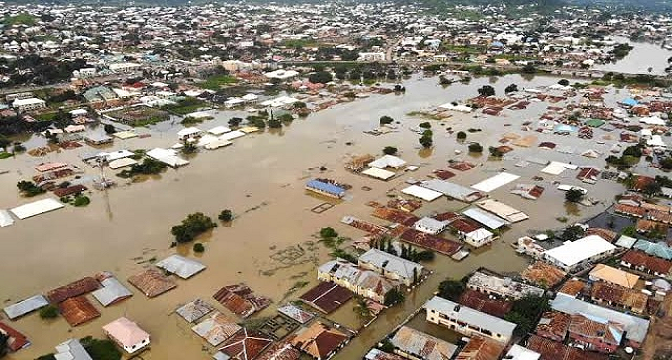
The Nigerian Minister of Water Resources and Sanitation, Joseph Utsev, has clarified that recent flooding and loss of life in Mokwa, Niger State, were not caused by water releases from the Kainji or Jebba Dams.
Speaking at a media briefing in Abuja on Tuesday, Mr. Utsev stated that the disaster was triggered by heavy rainfall and residents' failure to heed flood warnings. He underscored that both dams remain structurally sound and pose no threat to downstream communities.
The minister extended the federal government's condolences to Niger State's government and affected residents, while praising the swift response of state authorities, local leaders, and emergency workers in delivering aid to victims.
Utsev explained that the flooding was caused by extreme weather conditions resulting from climate change, which overwhelmed the local drainage systems.
He pointed out that unregulated building and construction activities had obstructed an ephemeral tributary of River Dingi, a minor watercourse that only flows during periods of rainfall and is a tributary of the River Niger.
The absence of efficient alternative channels to redirect the excess water significantly worsened the flood's impact on the affected communities.
The minister recalled that the Nigeria Hydrological Services Agency (NIHSA), under the Federal Ministry of Water Resources and Sanitation, had issued the 2025 Annual Flood Outlook (AFO) on 10 April 2025, which predicted flooding in 19 Local Government Areas in Niger State, including Mokwa.
Citing the same report, he said 1,249 communities in 176 local government areas across 33 states and the Federal Capital Territory fall within High Flood Risk Areas, while 2,187 communities in 293 LGAs across 31 states and the FCT are classified under Moderate Flood Risk Areas.
States listed under the High Risk category include Abia, Adamawa, Akwa Ibom, Anambra, Bauchi, Bayelsa, Benue, Borno, Cross River, Delta, Ebonyi, Edo, FCT, Gombe, Imo, Jigawa, Kebbi, Kogi, Kwara, Lagos, Nasarawa, Niger, Ogun, Ondo, Osun, Oyo, Rivers, Sokoto, Taraba, Yobe, and Zamfara.
Utsev used the occasion to reiterate key warnings and recommendations from the 2025 AFO, urging states and local governments to strengthen drainage infrastructure, relocate vulnerable communities, sustain public awareness campaigns, and enforce land-use regulations to prevent encroachment into flood-prone areas.
Cloud Tag: What's trending
Click on a word/phrase to read more about it.
Alfa Belgore Abatemi-Usman Chief Imam Of Omu-Aran Ajasse-Ipo National Democratic Congress Ajakaye Ibrahim Bio Babaloja-General Quareeb Islamic Association Bashir Badawi Abdulwahab Ololele Islamiya Abdulraheem Aminat Omodara Saraki Raliat AbdulRazaq Aasiyat Bello Oyedepo Garba Ayodele Wahab Saliu Mustapha Yoonus Kola Olatinwo Malete Obayomi Azeez Amuda Aluko MalHub Ahmed Dankaya Olatunde Oyeyiola Maimunat Oloriegbe Adamu Attah Galadiman Ngeri Sardauna Of Ilorin Saadu Yusuf Mary Kemi Adeosun College Of Arabic And Islamic Legal Studies Fatimah Abdulkadir Oladipo Akanmu Tolani Abdullahi Adisa Akodudu James Kolo NIPOGA Raji Ayodele Kamaldeen Abdulkadir Bolakale Sakariyah Offa Poly Baba Isale Yakub Lai Gobir Abdulkadri Ahmad Alaiye Elewu Association Of Kwara State Online Media Practitioners Kwara Apc General Hospital Nigerian Supreme Council For Islamic Affairs Sulyman Abdulkareem Bolakale Kawu New Nigeria People’s Party Olomu Of Omu-Aran Nigeria Customs Service Aisha Ahman Pategi Rebecca Bake Funmilayo Zubair Laduba Ministry Of Women Affairs And Social Development Bayo Onimago Jaigbade Alao Wahab Isa Michael Imoudu National Institute For Labour Studies Olabimpe Olani Idris Amosa Saidu Ojuekun Abubakar Kawu Baraje Muslim Stakeholders Of Kwara State Fatima Abolore Jimoh Forgo Battery Susan Modupe Oluwole C2c@kwarastate.gov.ng Olatunji Ibrahim Erubu Oba Zubair Baba Issa Awoye Akanbi-Oke Naira Redesign Oba David Oyerinola Adedunmoye