


Deputy Senate President Barau Calls For Executive-Legislature Synergy To Save Democracy
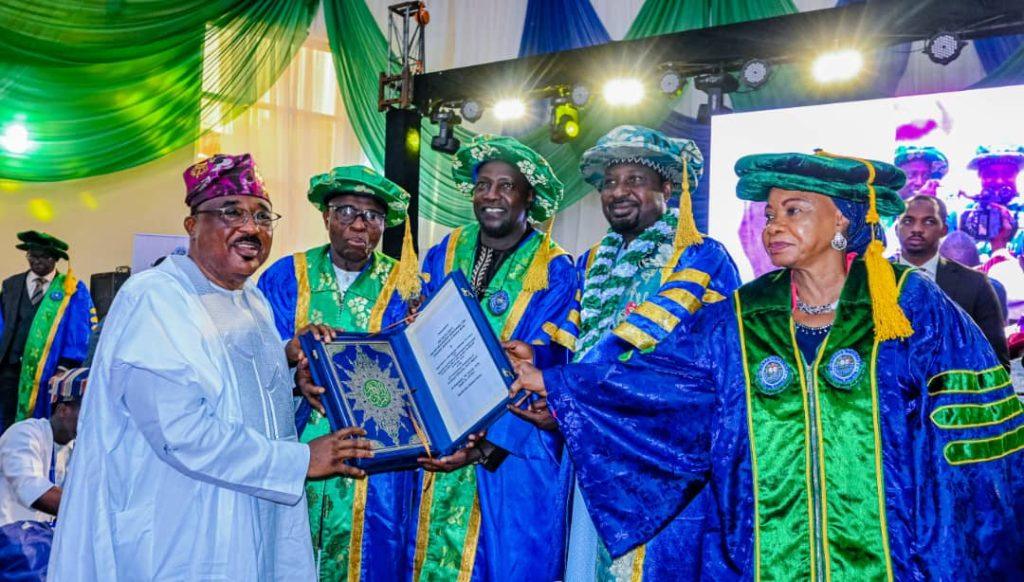
Nigeria's Deputy Senate President, Senator Barau Jibrin, has advocated for stronger cooperation and mutual respect between the Executive and the Legislature, describing it as a critical pathway to consolidating democracy in the country's Fourth Republic.
Senator Barau gave this charge in Ilorin, Kwara State, while delivering the convocation lecture at the 15th convocation ceremony of Al-Hikmah University. He warned that persistent friction between these two arms of government continues to weaken governance outcomes and erode public trust in democratic institutions.
The lecture, titled "Managing Executive-Legislature Relations towards Democratic Consolidation in Nigeria's Fourth Republic," provided a deep dive into how inter-institutional relations have impacted democratic stability since Nigeria's return to civil rule in 1999.
Barau noted that while Nigeria has achieved relative democratic endurance over the past two and a half decades, the quality of governance remains largely dependent on the effective management of constitutional boundaries and shared responsibilities. He urged leaders to prioritise the national interest over institutional rivalry to ensure the dividends of democracy reach the citizens.
Democratic Consolidation
He noted that democratic consolidation goes beyond the conduct of periodic elections and must include strict adherence to constitutionalism, separation of powers, accountability, and the rule of law.
According to him, early years of the Fourth Republic were characterised by intense confrontations between the Presidency and the National Assembly over leadership tussles, budgetary processes, impeachment threats, and oversight functions, developments he said reflected institutional weaknesses inherited from years of military rule.
The Senate leader identified executive dominance, weak legislative capacity, partisan rivalry, and personalisation of power as major drivers of such conflicts.
He stressed that legislative oversight should not be viewed as hostility but as a constitutional responsibility aimed at ensuring accountability and transparency in governance, warning that politicisation of oversight erodes public confidence in democratic institutions.
Budget Delays
Barau also said budget delays in Nigeria often stem from deficits in trust and poor engagement rather than flaws in the 1999 Constitution, stating that effective governance requires timely dialogue and respect for institutional mandates.
He highlighted the role of political parties in shaping executive-legislature relations, cautioning that excessive executive control of party structures undermines legislative independence and weakens democracy.
To strengthen democratic governance, Barau advocated regular structured engagement between both arms of government, enhanced legislative capacity through research and institutional support, strict adherence to constitutional provisions, and improved civic education.
He cited the establishment of the National Institute for Legislative and Democratic Studies and the National Assembly Library Trust Fund as reforms aimed at strengthening legislative effectiveness and reducing political tensions experienced in the early years of the Fourth Republic .
The lawmaker also urged political leaders to place national interest above personal ambition, arguing that ethical leadership remains central to Nigeria's democratic future.
Addressing the graduating students, Barau charged them to uphold democratic values and contribute to accountable governance, describing democracy as a system sustained not only by institutions but by enlightened citizens.
He commended Al-Hikmah University for promoting knowledge integrated with moral and civic responsibility, and expressed optimism that Nigeria's democracy would continue to grow in strength and stability.
The event was attended by dignatories across the country and beyond including the the Kwara State Governor, Mallam Abdulrahman AbdulRazaq, who was represented by his deputy, Mr. Kayode Alabi, the former Chief of Staff to late President Muhamadu Buhari, Professor Ibrahim Gambari.
Others are, the Founder of the University, Alhaji Raimi Oladimeji, the Arogundade of Lagos and Jagunmolu of Igbominaland, the Ciroma of Ilorin, Prince Abubakar Bature Sulu -Gambari SAN, and the Kuliyan Ngeri of Ilorin, Yusuf Olaolu Alli, SAN as well as the President of NACCIMA, Alhaji Jani Ibrahim.
Cloud Tag: What's trending
Click on a word/phrase to read more about it.
Donatus Ejidike Split Diamond Interchange AIT Ilorin Kwara Metro Park Air Peace Wole Oke Nigerian Army Oniwasi Agbaye Olukotun Of Ikotun Abdullahi AbdulMajeed Atiku Adama Isa Ajia-Bako Ejidongari REO CAKES Sheikh Hamzat Yusuf Ariyibi Ali Ahmad Special Agro-industrial Processing Zone Bola Magaji PharmAccess Foundation Elerin Of Adanla Irese Suleiman Ajadi Ilorin Curfew Lukman Adeloyin Abdulkadir Akanbi-Oke Ilorin Talaka Parapo (ITP) Quran Nigeria Computer Society Oba Abdulkadir La\'aro Atiku Abubakar Niyi Ogundiran Abubakar Kawu Baraje Ile Arugbo Adewuyi Funmilayo Amoyo Bayo Ajia KWSUED Adamu Jemilat-Baki Isiaka Rafiu Mope Alapado Balikis Jawondo Oko Erin Yakubu Mohammed Abdullahi SSA Youth AbdulFatai Adeniyi Dan-Kazeem Aiyedun Amuda Bembe Lateef Alagbonsi Emir Of Kano Anilelerin Ibraheem Abdullateef Tunde Idiagbon Road Bola Ahmed Tinubu Maigida Soludero Transit Aliyu U. Tilde Arik Summit University Hydroelectric Power Producing Areas Development Commission Sabo-Oke Mohammed Halidu Yekini Adio Ibrahim Oloriegbe Umar Gunu Kwara Consultative Forum Volunteers Of Ilorin Community And The Emirate Kisra A.G.F Abdulrasaq Oluwatoyin Lukman Apaokagi Basic Education Certificate Examination Olaitan Adefila Ishaq Salman Adedipe Geri-Alimi Split Diamond Interchange Alagbado Saraki Isaac Gbenle