


Kwara, UNICEF Train 60 Frontline Health Workers to Improve Maternal, Newborn Care
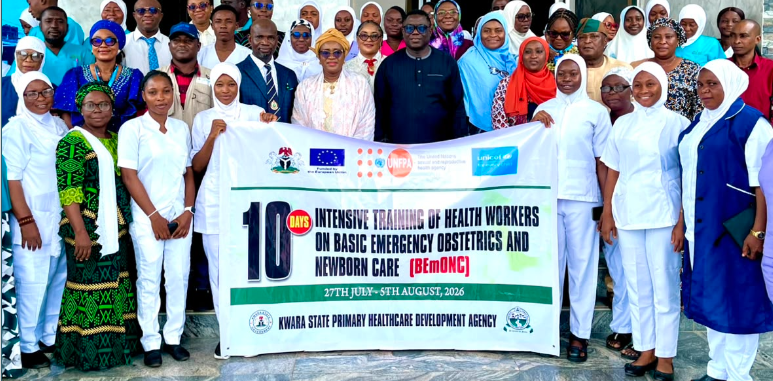
The Kwara State Primary Health Care Development Agency (KWSPHCDA), in partnership with UNICEF, has trained 60 frontline health workers, including doctors, nurses and midwives, in Basic Emergency Obstetric and Newborn Care (BEmONC) to improve maternal and newborn healthcare across the state.
The participants were selected from primary healthcare facilities in all 16 local government areas of Kwara State.
The capacity-building programme is aimed at equipping healthcare professionals with the knowledge and practical skills required to provide quality emergency obstetric and newborn care, ultimately reducing maternal and neonatal deaths and complications.
Speaking at the training, the Executive Secretary of KWSPHCDA, Prof. Nusirat Elelu, described the initiative as a valuable opportunity for participants to strengthen their clinical skills under the guidance of experienced facilitators.
She said maternal and newborn health remains a priority for the Kwara State Government and its development partners, with significant investments being made to improve healthcare outcomes.
Prof. Elelu stressed that the resources committed to the programme must translate into measurable improvements in service delivery, urging participants to apply the knowledge gained in their respective health facilities.
She also encouraged them to cascade the training to their colleagues to ensure wider impact across the state's primary healthcare system.
Earlier, the Director of Primary Health Care Systems, Dr Michael Oguntoye, described the workshop as timely, noting that it aligns with ongoing efforts to significantly reduce maternal and child mortality in Kwara State.
He explained that experienced facilitators were carefully selected to provide practical, high-impact training that would strengthen emergency care at the primary healthcare level.
Speaking on behalf of the facilitators, Prof. Raji Laide of the Department of Obstetrics and Gynaecology at the University of Ilorin Teaching Hospital (UITH) emphasised the importance of equipping primary healthcare workers with life-saving emergency obstetric and newborn care skills.
She noted that strengthening primary healthcare centres, which often serve as the first point of contact for patients, would reduce unnecessary referrals to tertiary hospitals, ease pressure on higher-level facilities and help prevent avoidable maternal and newborn deaths.
Prof. Laide urged participants to actively engage in the practical sessions to maximise the benefits of the training.
Cloud Tag: What's trending
Click on a word/phrase to read more about it.
Wahab Egbewole GGDSS Pakata Razaq Atunwa Temi Kolawole Baruten Manzuma Nurudeen Muhammed Ahmad Lawan Ajibola Ademola Julius Sulu Babaita Isiaka Saka Balikis Kehinde Na\'Allah Tinubu Legacy Forum Gbugbu International Market Kehinde Baale Abdulsalam Firdaous Amosa IYA ALFA NLA Kumbi Titilope Sheikh Ariyibi Mogaji Aare Standard Organization Of Nigeria Taiwo Joseph Mohammed Haruna AbdulHakeem Ajibola Akanbi Lukman Oyebanji Fagbemi Ndakene Kisira Park Air Peace Adamu Ibrahim Sabi Olanrewju Okanlawon Musa Kassim Babamale Zulu Gambari Rex Olawoye Abdullahi Atanda A.O. Belgore Agbarere Gambari Doyin Group Young Progressives Party Assayomo Issa Baba Olushola Saraki Freshvine Nigeria Limited Kayode Zubair Balogun Fulani Waziri Yakubu Gobir Societe Generale Bank Of Nigeria Eghe Igbinehi Musa Ayinla Yeketi Yakubu Dogara Mubarak Oladosu Fatimat Saliu Khadijat Ayoola Yusuf Moronfoye Sulaiman Gado Lanre Badmus Bareke Saad Omo\'ya Road Transport Employers Association Of Nigeria Olayinka Olaogun Bolakale Ayo Olofa Of Offa Danhawa Kwara State Internal Revenue Service Dapo Teni Nig Enterprise Afolabi-Oshatimehin Adenike Harriet Ilorin Emirate Owu Fall Neuropsychiatric Hospital Ibrahim Bio Naira Redesign Chief Imam Of Ilorin Titus Suberu-Ajibola Jimba Babatunde Babatunde Ajeigbe Ibrahim Oloriegbe